


250+ Years of Faith in America
CHURCH

STATE
A FAITHFUL POLITICS ORIGINAL SERIES - JUNE 30TH
About the Series
Religion has been part of the American story from the beginning. But where that story begins, and how religion shaped what followed, depends on who is telling it.
Church & State: 250+ Years of Faith in America looks at how faith has shaped American identity, institutions, law, politics, and public life - from Indigenous nations and European empires to the founding, slavery, civil rights, religious liberty, and today’s political debates.
We record this series in Virginia, where Indigenous peoples lived for more than 12,000 years before English arrival. By the late 1500s, Powhatan led a network of tribes across Tidewater Virginia known as Tsenacommacah. We honor the people and communities whose history began here long before America.
Launches:
Tuesday, June 30th
Where to listen/watch:
Available for free on our YouTube channel and on our podcast stream.
Release schedule: New episodes Tuesday, Thursdays and Saturdays


ORIGINS: BEFORE THE FOUNDING
Before there was a United States, there were already peoples, places, religious claims, and political systems shaping the land. This section begins before the founding to look at the ideas that came first - Indigenous presence, European empire, Christian mission, conquest, land, and the religious arguments used to explain power.
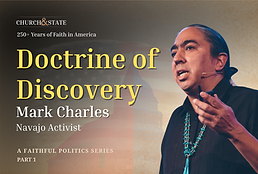
Mark Charles
Public speaker, writer, and activist of Navajo (Diné) heritage. His work focuses on U.S. history, Indigenous justice, and the doctrine of discovery. He brings a perspective that challenges traditional narratives about the founding and the role of Christianity in colonization.
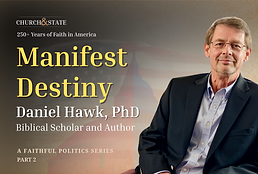
Dan Hawk, Ph.D.
Biblical scholar and professor specializing in Old Testament and postcolonial interpretation. His work often examines how scripture has been used in contexts of empire and colonization. He contributes theological depth to discussions of faith and power.
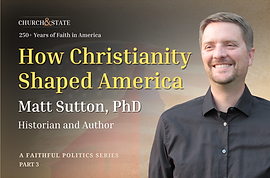
Matthew Sutton, Ph.D.
Historian at Washington State University specializing in American religion and evangelicalism. Author of The Chosen Land, he studies how Christianity has made America what it is today, and how America influenced Christianity.

FOUNDING: MAKING A NATION
The founding did not settle America’s religion question. It gave the country a framework for arguing over it. This section looks at how the founders, churches, states, and ordinary Americans understood liberty, authority, religious tests, disestablishment, and the early boundaries between church and state.

Katherine Carté, Ph.D.
Historian at Southern Methodist University specializing in religion and politics in early America. Her work focuses on how Protestant Christianity shaped political thought during the American Revolution, including ideas about liberty, authority, and national identity.
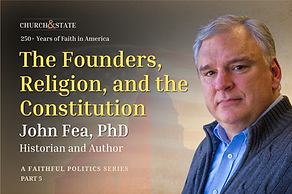
John Fea, Ph.D.
Explores how the Founders approached religion in the creation of the Constitution, including debates over religious freedom, church-state separation, and the role of faith in public life. The discussion examines how these decisions established the legal framework that continues to shape American governance.
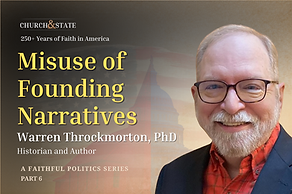
Warren Throckmorton, Ph.D.
Psychologist and former professor at Grove City College with a focus on religion, politics, and historical narratives. He has written extensively on the founders, Thomas Jefferson, and the role of religion in American public life. His work often addresses misinformation and contested claims about the founding era.

CONFLICT: BELIEF MEETS POWER
Religious belief has often met its hardest tests in America’s conflicts over race, slavery, freedom, and citizenship. This section looks at how Christianity was used to defend power, resist oppression, and shape the long struggle over who belonged in America.

Robert P. Jones, Ph.D.
President of the Public Religion Research Institute (PRRI) and a leading scholar of religion and public life in the U.S. His work focuses on the intersection of faith, race, and politics, using large-scale survey data to track trends like Christian nationalism. Author of The End of White Christian America, he provides data-driven insight into how religion is reshaping American identity.
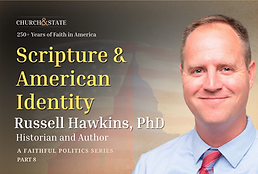
Russell Hawkins, Ph.D.
Historian of American religion and evangelicalism and Executive Director of the LEAD Center at Baylor University. His work focuses on the development of evangelical identity, institutions, and leadership in modern U.S. history. He brings a historical lens to how religious movements organize, adapt, and influence public life.

Katharine Gerbner, PhD
Historian of religion, slavery, and freedom at the University of Minnesota. Author of Christian Slavery, her work examines how Protestant Christianity shaped ideas about race, conversion, and enslavement in the Atlantic world. She helps explain how religion became tied to racial hierarchy in early American history.
POWER: FIGHTING FOR INFLUENCE
Religion has never only shaped private belief. It has shaped institutions, leadership, media, law, music, gender roles, and public authority. This section looks at how religious communities have fought over influence - who gets it, who challenges it, and how faith wield that power.
.png)
Andrew L. Seidel, J.D.
Constitutional attorney and Vice President of Strategic Communications at Americans United. Author of The Founding Myth and American Crusade, his work examines Christian nationalism, religious liberty, and the legal battles shaping church-state separation in America.
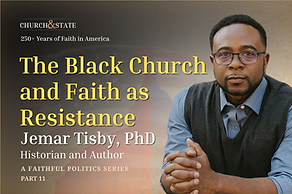
Jemar Tisby, Ph.D.
Historian and author of The Color of Compromise. His work examines how race and Christianity have developed together in the United States. He connects historical patterns to present-day issues of justice, faith, and public life.
.png)

Leah Payne, Ph.D.
Historian of American religion and popular culture at Portland Seminary. Author of God Gave Rock & Roll to You, her work examines how Christian music, media, and worship shaped evangelical identity, political activism, and American religious life.
Kristin Du Mez, Ph.D.
Historian at Calvin University and author of Jesus and John Wayne. She studies how evangelical culture, gender, and ideas about power have shaped political life in modern America. Her work traces how these influences impact leadership, identity, and public authority.

PRESENT: FAITHFUL POLITICS
Religion continues to shape American politics through identity, media, movements, and public institutions. This section looks at the forces defining faith and power in America today.

Andrew L. Whitehead, Ph.D. & Samuel L. Perry, Ph.D.
Sociologists and co-authors of Taking America Back for God, their research defines Christian nationalism as a cultural framework and uses national survey data to measure its impact. Their work examines how these beliefs intersect with race, gender, and authority, and how they shape political behavior and public life in the United States.

Matthew D. Taylor, Ph.D.
Scholar of religion and politics and author of The Violent Take It by Force. His research focuses on charismatic Christianity, extremism, and how religious ideas mobilize political action. He analyzes how theological movements translate into real-world influence.

Brian Kaylor, Ph.D.
Journalist and president of Word&Way. His reporting focuses on how religious language and ideas are used in politics and public institutions. He brings a current, investigative perspective on the role of faith in today’s political landscape.
